
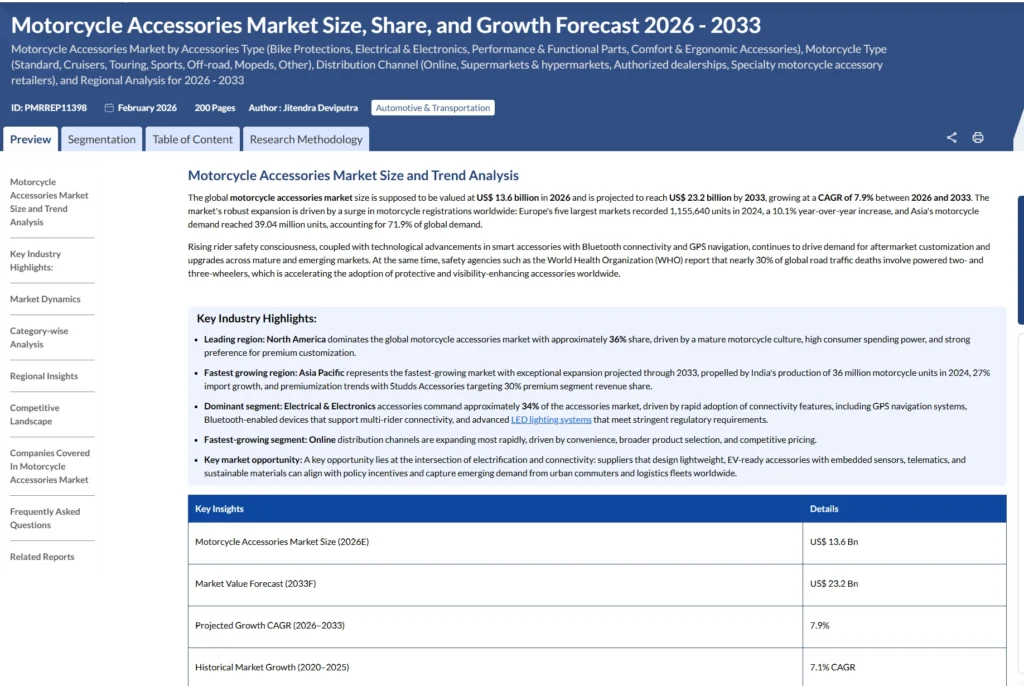

The global motorcycle accessories market size is supposed to be valued at US$ 13.6 billion in 2026 and is projected to reach US$ 23.2 billion by 2033, growing at a CAGR of 7.9% between 2026 and 2033. The market’s robust expansion is driven by a surge in motorcycle registrations worldwide: Europe’s five largest markets recorded 1,155,640 units in 2024, a 10.1% year-over-year increase, and Asia’s motorcycle demand reached 39.04 million units, accounting for 71.9% of global demand.
Rising rider safety consciousness, coupled with technological advancements in smart accessories with Bluetooth connectivity and GPS navigation, continues to drive demand for aftermarket customization and upgrades across mature and emerging markets. At the same time, safety agencies such as the World Health Organization (WHO) report that nearly 30% of global road traffic deaths involve powered two- and three-wheelers, which is accelerating the adoption of protective and visibility-enhancing accessories worldwide.
Key Industry Highlights:
1.Leading region: North America dominates the global motorcycle accessories market with approximately 36% share, driven by a mature motorcycle culture, high consumer spending power, and strong preference for premium customization.
2.Fastest growing region: Asia Pacific represents the fastest-growing market with exceptional expansion projected through 2033, propelled by India’s production of 36 million motorcycle units in 2024, 27% import growth, and premiumization trends with Studds Accessories targeting 30% premium segment revenue share.
3.Dominant segment: Electrical & Electronics accessories command approximately 34% of the accessories market, driven by rapid adoption of connectivity features, including GPS navigation systems, Bluetooth-enabled devices that support multi-rider connectivity, and advanced LED lighting systems that meet stringent regulatory requirements.
4.Fastest-growing segment: Online distribution channels are expanding most rapidly, driven by convenience, broader product selection, and competitive pricing.
5.Key market opportunity: A key opportunity lies at the intersection of electrification and connectivity: suppliers that design lightweight, EV-ready accessories with embedded sensors, telematics, and sustainable materials can align with policy incentives and capture emerging demand from urban commuters and logistics fleets worldwide.


